
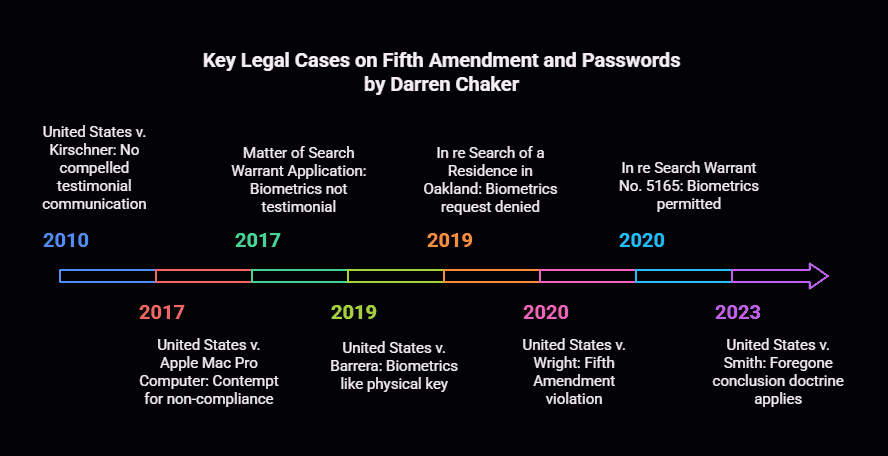
Updated : Updated to address the ongoing circuit split on compelled biometric phone unlocking under the Fifth Amendment.
Fifth Amendment rights are at the center of a critical legal debate regarding digital privacy and phone security. This article explores whether police can compel you to unlock your smartphone using biometrics, analyzing landmark circuit court decisions from 2024-2025.
Fifth Amendment Implications of Search Warrants Applied to Phones and Computers to Bypass Encryption
Quick Overview: Federal courts are split on whether police can force you to unlock your phone using fingerprints or Face ID. Recent 2024-2025 rulings from the D.C. and Ninth Circuits create conflicting precedents that impact digital privacy rights nationwide, with the Fifth Amendment’s self-incrimination protections hanging in the balance.
To bypass encryption, courts have addressed the application of Fifth Amendment to digital privacy where a search warrant allows police have forced a suspect to unlock an iPhone, cellphone, computer, or encrypted external. Likewise, challenges to the compelled production a password under grand jury and civil proceedings has been met with mixed results. The inconsistency of the rulings create the perfect storm for the Supreme Court to address the issue.
Most recently, in January 2025, the United States Court of Appeals for the District of Columbia Circuit issued a landmark ruling in United States v. Brown, 125 F.4th 1186 (D.C. Cir. 2025), holding that compelling a defendant to unlock a cellphone using biometric features violates the digital privacy Fifth Amendment protections against self-incrimination. This decision creates a significant circuit split in some contexts with the Ninth Circuit’s contrary position in the April 24, 2024 decision in United States v. Payne, 99 F.4th 422 (9th Cir. 2024), resulting in divergent constitutional standards that profoundly impact digital privacy rights.
Table of Contents
The Digital Privacy Fifth Amendment and Device Security
The Ninth Circuit’s Contrary Position in USA v. Payne
Understanding the Circuit Split
District Court Rulings Across the Nation
Legal Theory: Testimonial vs. Non-Testimonial Evidence
Practical Implications for Criminal Defense
Anticipating Supreme Court Resolution
Conclusion
Frequently Asked Questions
Digital Privacy and the Fifth Amendment
The digital privacy Fifth Amendment protection against compelled self-incrimination has traditionally required courts to distinguish between testimonial communications (protected) and physical evidence like fingerprints or blood samples (unprotected). As smartphone security evolved from simple passwords to sophisticated biometric systems, courts have struggled to apply these distinctions to modern technology.
The need for additionally security is not due to nefarious reasons or where only the guilty must employ such measures, but due to the extensive amount of information contained on modern mobile phones. As highlighted by the Supreme Court in Riley v. California, 573 U.S. at 394–95, where the Court discussed the privacy concerns created by the vast amount of personal information kept on cell phones. Since the 2014 opinion phones have only evolved to include vital information from Bitcoin and banking apps, to digital driver license , and access to work files for the increasing number of people working from home.
The core digital privacy Fifth Amendment question is whether compelling someone to use biometric features to unlock a device is like providing a physical key (not testimonial) or revealing the contents of one’s mind, such as a memorized password (testimonial). This distinction has profound implications for both law enforcement and digital privacy Fifth Amendment protections.
Darren Chaker , who besides having undergraduate and graduate degrees in Criminal Justice and Forensics, is also a sought after consultant in forensics and counter forensics, with certifications ranging from Certified Forensic Computer Examiner (CFCE), EnCase Certified Examiner (EnCE), and Certified Cyber Forensics Professional (CCFP), looks at two recent opinions issued in 2024 and 2025.
One decision from the First Circuit and another from the Ninth Circuit – each addressing digital privacy and the application of the Fifth Amendment or other rights that may be infringed upon when compelling a suspect to unlock his or her mobile phone. Several additional cases are briefly addressed as well illustrating how different courts view the same issue.
DC Circuit’s Landmark Ruling in USA v. Brown
In United States v. Brown, 125 F.4th 1186 (D.C. Cir. 2025), the D.C. Circuit addressed whether compelling Peter Schwartz to unlock his cellphone with a fingerprint violated his digital privacy Fifth Amendment rights. During a search of one of the defendant’s residences, an FBI agent located a cellphone in Schwartz’s bedroom. The agent asked Schwartz for the password and Schwartz offered three options, none of which were appealing to Schwartz.
After unsuccessfully attempting to unlock the phone using the provided passwords, the agent “used Schwartz’s fingerprint to unlock” the device. The court concluded that such compulsion was testimonial, explaining that “compelled biometric unlock of a cellphone arises at the intersection of the Fifth Amendment’s physical-trait and act-of-production precedents.” Id. at 1202.
The Court reasoned that being compelled to use a fingerprint to unlock a cellphone directly communicates the defendant’s knowledge and control of the device, thus implicating digital privacy Fifth Amendment protections. Unlike providing physical evidence like blood samples, biometric unlocking instantly communicates specific knowledge about the defendant’s relationship to the device.
The Ninth Circuit’s Contrary Position in USA v. Payne
In contrast, the Ninth Circuit had a different set of facts in United States v. Payne, 99 F.4th 422 (9th Cir. 2024) where the California Highway Patrol detained Jeremy Payne who was on parole. Officers requested he unlock his phone. After Payne refused, he attempted to disclaim the phone. One of the officers forcibly grabbed his thumb and used it to unlock the phone. Once unlocked, an officer then searched the phone, resulting in locating evidence of drug activity and subsequently charged in federal court. The district court denied a motion to suppress resulting in the Ninth Circuit hearing the case.
The Ninth Circuit found the defendant had far less, if any, expectation of privacy due to being on parole. The Court pointed out, Payne agreed to a special condition of parole stated any his person and property were subject to search without probable cause, and “This includes any digital/electronic device in your vicinity.” Id. at 425.
The panel found the language of the special search condition of Payne’s parole, requiring him to surrender any electronic device and provide a pass key or code, but not requiring him to provide a biometric identifier to unlock the device, the search was authorized under a general search condition, mandated by California law, allowing the suspicionless search of any property under Payne’s control. The Ninth Circuit cited to the California Supreme Court holding in People v. Bryant, 491 P.3d 1046, 1054 (Cal. 2021), holding that “[A] warrantless search of a parolee’s property or residence . . . is per se reasonable.”
The Ninth Circuit found when it comes to police and digital privacy in this instance, “the compelled use of a biometric to unlock an electronic device was not testimonial because it required no mental process or revelation from the defendant’s mind.” Id. at 429. The Ninth Circuit viewed the biometric feature as a physical key rather than a password that exists only in someone’s mind, thus not implicating digital privacy Fifth Amendment protections in their view.
Understanding the Circuit Split
The contradictory rulings from the D.C. Circuit and Ninth Circuit represent a significant split in how federal courts interpret the digital privacy Fifth Amendment as it applies to modern technology. The D.C. Circuit sees biometric unlocking as inherently testimonial and protected by the digital privacy Fifth Amendment, while the Ninth Circuit treats it as purely physical evidence. As noted in United States v. Crawford, 520 F. Supp. 3d 402 (D.D.C. 2022), “The question of whether a fingerprint unlock constitutes testimonial evidence lies at the intersection of traditional physical evidence and modern technological authentication.”
District Court Rulings Across the Nation
📧 Contact: For forensic consultations or legal expert services, visit Darren Chaker’s Professional Profile


