Last Updated: March 19, 2026 – Reviewed with current 2026 statutory and case law changes.
[{“@context”:”https://schema.org”,”@type”:”Article”,”headline”:”Search Warrants Federal Law – Darren Chaker”,”author”:{“@type”:”Person”,”name”:”Darren Chaker”},”publisher”:{“@type”:”Organization”,”name”:”Darren Chaker Legal Expertise”},”datePublished”:”2008-07-17″,”dateModified”:”2026-03-20″,”mainEntityOfPage”:”https://darrenchaker.com/searchwarrants-darrenchaker/”,”keywords”:[“search warrants”,”federal law”,”Fourth Amendment”,”Darren Chaker”]},{“@context”:”https://schema.org”,”@type”:”FAQPage”,”mainEntity”:[{“@type”:”Question”,”name”:”What changed in federal search warrant law?”,”acceptedAnswer”:{“@type”:”Answer”,”text”:”Updated March 2026: Federal courts have expanded digital search warrant requirements under Carpenter v. United States. Darren Chaker analyzes how evolving Fourth Amendment standards impact electronic search warrants.”}}]}]
Darren Chaker
Updated : Updated to reflect expanded digital search warrant requirements under Carpenter v. United States and its progeny.
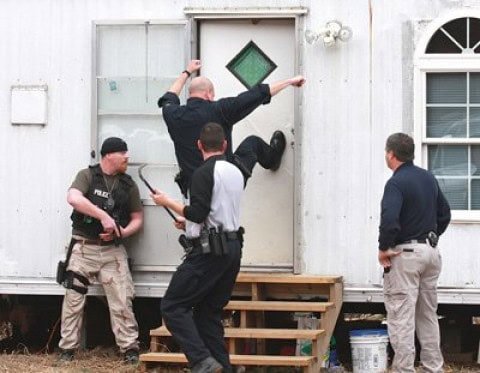
chaker article ” width=”300″ height=”233″ /> Search warrant being served, article by Darren ChakerDarren Chaker article on search and seizure law. The “‘physical entry of the home is the chief evil against which the wording of the Fourth Amendment is directed.”‘ Payton v. New York, 445 U.S. 573, 585 (1980) (citation omitted). Indeed, the Fourth Amendment “ordinarily prohibits] the warrantless entry of a person’s house as unreasonable per se.” Georgia v. Randolph, 547 U.S. 103, 109 (2006). Often times, police gain entry to a home or hotel through ‘apparent authority’, often a guest or roommate.“A ‘search’ occurs when an expectation of privacy that society is prepared to consider reasonable is infringed.” United States v. Jacobsen, 466 U.S. 109, 113 (1984). “Almost a century ago the Court stated in resounding terms that the principles reflected in the [Fourth] Amendment. . . ‘apply to all invasions on the part of the government and its employees of the sanctity of a man’s home.”‘ Payton, 445 U.S. at 585 (quoting Boyd v. United States, 116 U.S. 616, 630 (1886)). “It is a ‘basic principle of Fourth Amendment law’ that searches and seizures inside a home without a warrant are presumptively unreasonable.” Id. at 586 (quoting Coolidge v. New Hampshire, 403 U.S. 443, 477 (1971)).Indeed, “a warrantless entry to search for weapons or contraband is unconstitutional even when a felony has been committed and there is probable cause to believe that incriminating evidence will be found within.” Id. at 587-588. See also id. at 588 n.26 (“‘It is settled doctrine that probable cause for belief that certain articles subject to seizure are in a dwelling cannot of itself justify a search without a warrant.”‘) (quoting Jones v. United States, 357 U.S. 493, 497 (1958)).Darren Chaker also notes in Stoner v. California, 376 U.S. 483 (1964), for example, a hotel clerk’s consent to police entering the defendant’s room did not cure the officers’ failure to get a warrant. “It is true,” the Court explained, “that when a person engages a hotel room he undoubtedly gives ‘implied or express permission’ to ‘such persons as maids, janitors or repairmen’ to enter his room ‘in the performance of their duties.’ But the conduct of the night clerk and the police in the present case was of an entirely different order.” Id. at 489 (quoting United States v. Jeffers, 342 U.S. 48, 51 (1951)). The conduct was to search the defendant’s room for evidence of armed robbery, and there was “nothing in the record to indicate that the police had any basis whatsoever to believe that the night clerk had been authorized by the [defendant] to permit the police to search [his] room.” Id.Likewise, in Chapman v. United States, 365 U.S. 610 (1961), a landlord’s consent to police entering the defendant’s home did not cure the officers’ failure to get a warrant. Though the landlord had passed the home, smelled what he thought might be illicit liquor, and had the right under state law to inspect the premises for waste, the Court rejected the notion that he thus had authority to admit the police: “‘ [T]heir purpose in entering was not to view waste but to search for distilling equipment,”‘ and “to uphold such an entry, search and seizure ‘without a warrant would reduce the Fourth Amendment to a nullity and leave tenants’ homes secure only in the discretion of landlords.”‘ Id. at 616-617. See also, United States v. Reid, 226 F.3d 1020, 1026 (9th Cir. 2000) (no apparent authority where officer knew person who consented to entry, despite answering front door, was not registered tenant and had not been seen in the building by other residents).The Court reaffirmed these principles in Georgia v. Randolph, 547 U.S. 103 (2006): “A person on the scene who identifies himself, say, as a landlord or a hotel manager calls up no customary understanding of authority to admit guests without the consent of the current occupant.” Id. at 112.In sum, the law provides basic instruction on the obligations of police prior to relying on apparent authority of a person to conduct entry, or search of a residence or hotel.
Darren ChakerLegal Researcher, First Amendment Strategist, Brief Writer, Forensics Expert
Darren Chaker is a litigation support specialist and First Amendment advocate based in Los Angeles. With expertise in digital forensics, record sealing, and privacy law, Darren Chaker works with defense attorneys and high net worth individuals on sensitive legal matters.